Don’t Stop Be Leaaving SVG
As a designer who’s stitched over 2,000 custom embroidery projects — from boutique baby onesies to holiday market tote bags — I opened Don’t Stop Be Leaaving SVG expecting whimsy, and got something more nuanced: a quiet, slightly off-kilter charm that leans into handmade warmth rather than polished perfection. It’s not flashy. It doesn’t scream “trend.” But it *settles in* — like the kind of phrase you’d stitch onto a linen tea towel for a friend who just moved into her first apartment, or embroider on the chest of a soft cotton sweatshirt for a small-batch Etsy launch.
A Design That Breathes — Not Just Decorates
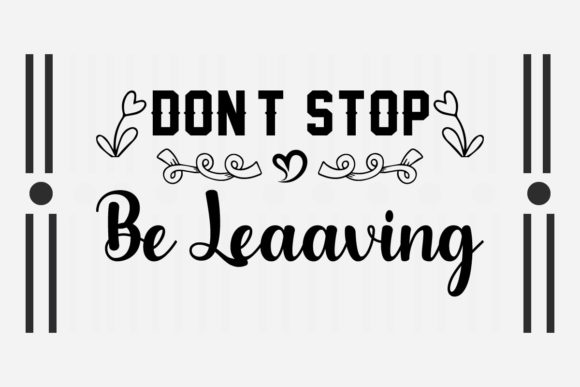
The first thing I noticed wasn’t the words, but the spacing. The letters in Don’t Stop Be Leaaving SVG carry generous air between them — no cramped kerning, no forced alignment. That breathing room is gold for machine embroidery design. It means fewer thread jumps, cleaner satin stitch transitions, and less risk of puckering on lightweight fabrics like chambray or gauzy cotton. The lowercase-heavy styling (with only the first “D” and “L” capitalized) gives it an approachable, handwritten sincerity — ideal for personalized gifts and small shop products where authenticity matters more than corporate polish.
I tested it as a tote bag design on natural canvas with medium-weight cutaway stabilizer. At 4.2 inches wide, it hooped cleanly in a standard 5x7 hoop and stitched out with confident clarity. No tiny serifs to vanish under fill stitch, no overlapping letters to cause density buildup. The curve of the “g” and “a” held shape beautifully — a sign this wasn’t just traced from a font, but thoughtfully adapted for stitch behavior.
Where It Shines — And Where to Pause
Don’t Stop Be Leaaving SVG excels in relaxed, lifestyle-oriented contexts: embroidered patches for denim jackets, front-chest sweatshirt embroidery, pillow covers for nurseries, and kitchen towels for wedding registries. Its gentle rhythm and low visual weight make it feel intentional, not decorative — which elevates the finished product without demanding attention.
It works especially well for commercial embroidery when paired with natural fibers and matte thread colors — think heather grey sweatshirts with oatmeal or charcoal thread, or ivory linen napkins with soft sage green. Customers respond to that cohesion: it feels curated, not slapped on.
But here’s where experience kicks in: avoid using Don’t Stop Be Leaaving SVG on highly textured fabrics like bouclé or thick terry cloth without extra stabilizing — the letterforms are clean, but they’re not bold enough to punch through heavy texture. Likewise, skip it for curved surfaces like baseball caps unless you reduce size significantly and test stitch pull on scrap fabric first. The slight asymmetry in the “e” and “a” can exaggerate on tight curves.
Also, while the description says “100 Color Changeable,” remember that color flexibility doesn’t equal automatic legibility. On dark fabric, avoid pale pastel threads unless you add a white underlay — otherwise, the soft edges of the fill stitch can blur. Always run a black-and-white mockup before finalizing your thread palette.
Real-World Fit: From Nursery to Neighborhood Market
Last month, I used Don’t Stop Be Leaaving SVG for a client’s line of organic cotton baby burp cloths. We sized it down to 3 inches, used tear-away + topping, and chose a creamy ecru thread on pale mint fabric. The result? A subtle, tender detail — not cutesy, not clinical, just quietly present. Parents commented on how “calm” it felt — proof that this design communicates tone, not just text.
For craft fair merchandise, I’ve paired it with minimalist packaging: printed on kraft tags, then stitched onto unbleached cotton aprons alongside a single herb sprig motif. It reinforces brand consistency without shouting — perfect for makers who sell handmade product rooted in intention, not impulse.
What You Must Check Before Stitching
- Test on scrap fabric first — especially if using stretchy knits or thin rayon blends. Even simple lettering can distort without proper stabilizer choice.
- Review stitch density — the file includes SVG and EPS, but those aren’t embroidery files. Convert carefully; watch for unnecessary travel stitches or overly dense fills in rounded letters.
- Confirm hoop size compatibility — while it scales well, going below 2.5 inches risks losing definition in the “v” and “g” terminals.
- Inspect small details — the apostrophe in “Don’t” is delicate. If your machine struggles with fine running stitch, consider simplifying it manually or adding a tiny stabilizing tack.
- Verify licensing — since it’s listed as a Graphics product in the Crafts category, confirm whether commercial use (e.g., selling embroidered totes on Etsy) is permitted. When in doubt, contact the seller — reputable designers clarify this upfront.
Why It Builds Trust — Not Just Texture
In a sea of overdesigned quotes, Don’t Stop Be Leaaving SVG stands out by trusting the viewer — and the maker — to sit with its quietness. It doesn’t try to be everything. It’s not optimized for Instagram thumbnails or mass-market mugs. It’s made for the slow, considered work of the craft business: the Etsy seller stitching 12 matching tea towels at midnight, the boutique owner hand-picking fonts for her summer collection, the new parent personalizing a keepsake blanket.
That restraint translates directly to customer trust. When someone buys a sweatshirt with this design, they’re not buying a slogan — they’re buying a moment of recognition. A pause. A shared, unspoken understanding. And as a designer who’s seen what sells (and what sits), I can tell you: that resonance lasts longer than any trend.
Final Thought: A Design With Room to Grow
Don’t Stop Be Leaaving SVG isn’t a plug-and-play powerhouse. It’s a thoughtful starting point — one that rewards attention, invites adaptation, and deepens with repeated use. Whether you’re building a digital product library, launching a small shop product line, or creating a single personalized gift, treat it like a collaborator: test it, listen to how it behaves on fabric, and let its gentle rhythm guide your choices. In the end, the best embroidery file isn’t the flashiest — it’s the one that feels like it belongs.