Okay but Did You Call First SVG: Graphics for Crafts & Humor-Driven Branding
As a graphic designer who’s built brand identities for over 140 small businesses—from handmade soap studios to indie coffee roasters—I recently evaluated Okay but Did You Call First SVG for a client launching a seasonal “No-Appointments-Necessary” pop-up shop. The brief called for lighthearted, approachable visuals that softened the formality of service-based retail without undermining professionalism. Right away, this asset stood out—not as a logo candidate, but as a strategic graphic design asset for tone-setting across touchpoints.
A First Impression That Lands With Warmth and Wit
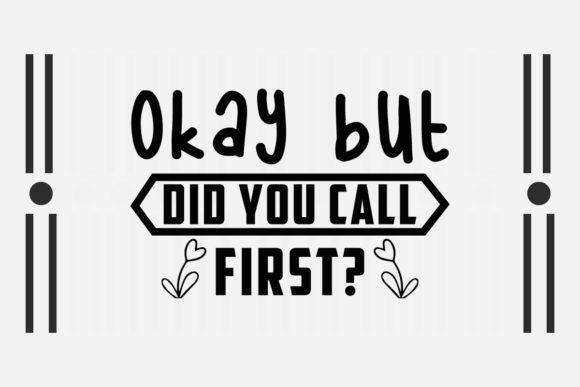
The design reads instantly: friendly, slightly cheeky, and intentionally conversational. It’s not minimalist—it leans into expressive typography with subtle weight shifts and gentle irregularity, evoking hand-lettered charm without sacrificing vector precision. There’s no forced quirkiness; the rhythm feels human, like something you’d see on a chalkboard at a neighborhood bakery or embroidered on a staff apron. That mood makes it ideal for handmade business branding, local event campaigns, and Etsy product lines where authenticity and relatability drive engagement.
Where It Shines in Real Client Projects
In our pop-up project, we deployed Okay but Did You Call First SVG across six key applications—and each time, it elevated cohesion without competing with core brand elements:
- Product mockups: Placed cleanly on ceramic mug and canvas tote mockups, it added instant personality while keeping focus on the product itself.
- Social media graphics: Used as a centered visual anchor in Instagram carousels and Pinterest pins—paired with clean sans-serif body copy, it created strong visual hierarchy and boosted shareability.
- Printable wall art: Scaled beautifully for 8×10 and 16×20 prints; its open letterforms held up even at 300 DPI on matte paper.
- Cricut projects: Cut flawlessly from vinyl and heat-transfer material—no node issues, no jagged edges. The clean vector paths made alignment and layering intuitive.
- Packaging design: Applied as a secondary motif on kraft mailer stickers and tissue wrap—small but legible, reinforcing brand voice without clutter.
- Editorial design: Integrated into a digital lookbook as a recurring decorative divider between sections—adding rhythm and thematic continuity.
This isn’t just a digital product; it’s a flexible creative design tool that supports storytelling across physical and digital channels.
Where Caution Is Required
Like any expressive type-based asset, Okay but Did You Call First SVG has boundaries. It doesn’t translate well to ultra-minimalist contexts—think luxury skincare labels or corporate investor decks—where restraint is non-negotiable. Avoid using it:
- At under 24pt in dense layouts (letter spacing tightens visually, hurting readability)
- Over complex or low-contrast backgrounds (test rigorously on light/dark surfaces—especially if repurposing for web banners)
- Alongside highly ornate script fonts (it competes rather than complements)
- In legal disclaimers or compliance-heavy materials (its casual tone undermines authority)
It also shouldn’t serve as primary logo design. Its strength lies in supporting roles: campaign accents, merch focal points, and mood-setting elements within a broader brand identity.
Designer Notes You Can’t Skip
Before clearing Okay but Did You Call First SVG for client use, I ran these checks:
- Test in grayscale: Confirmed legibility and contrast hold up—no hidden detail loss in black-and-white print runs.
- Preview at scale: Zoomed out to 10% to simulate mobile viewing; zoomed in to 400% to verify smooth curves and anchor point integrity.
- Mockup validation: Dropped it onto real-world product templates (Cricut Design Space, Placeit, Smartmockups)—no distortion, no rendering lag.
- Font pairing audit: Tested against Montserrat (sans), Playfair Display (serif), and Pacifico (script). It harmonized best with warm, grounded sans-serifs—avoid thin or geometric extremes.
- Licensing verification: Confirmed commercial license covers resale in print-on-demand and Etsy product contexts—critical for clients selling physical goods.
- File inspection: Opened both SVG and EPS versions in Illustrator—layers were ungrouped and editable; no raster embeds or hidden objects.
Why It Fits the Modern Creative Marketplace
This asset reflects what today’s creative marketplace demands: versatility without vagueness, personality without pretense. Unlike generic clipart, it carries tonal intention—making it valuable for marketing visuals, social media graphics, and packaging design where emotional resonance matters. Its “100 color changeable” claim holds true: the vector structure allows seamless fills, gradients, and duotones without degradation—ideal for sublimation design or multi-product campaigns.
For small business branding, it bridges the gap between DIY accessibility and pro-level polish. A craft vendor can drop it into Canva for a Facebook cover in under two minutes—or a designer can finesse it into a full Canva template suite with custom spacing, bleed guides, and brand-aligned palettes.
The Final Verdict for Client Work
Okay but Did You Call First SVG isn’t a one-size-fits-all solution—but when matched thoughtfully to the right project, it delivers disproportionate value. It strengthens audience engagement by injecting warmth into functional messaging. It boosts recognition through consistent, memorable phrasing. And because it’s truly ready to print and SVG design-native, it cuts down production friction without sacrificing quality.
If your client needs a printable design that feels human, a sticker design that sparks smiles, or a t-shirt design that invites conversation—not just decoration—this is a smart, tested addition to your design assets toolkit. Just remember: context is king. Use it where wit serves strategy, and let the rest of the design system handle clarity and trust.